Hot Topics
August 2026

It’s that time of year when sensible, civilized people take long breaks—the Italians with their Ferragosto, or August off, for one. We hard-charging Americans would well to follow their example, if only to give the planet a little respite from our endless endeavors making a handful of people rich by way of our rapine labors.
In that spirit, here’s a blast from the past while I trundle off into the desert heat. I hope reading it will find you on a quiet beach, or at a café in Paris, or in a kayak off the coast of Greenland. Anywhere, really, other than your usual haunts, enjoying a Ferrragosto of your own. See you in September.
Deserts
Desert. The word conjures up mystery, evokes the windswept fastnesses of Beau Geste and Lawrence of Arabia. That mystery may be a sign of its imprecision, for the term embraces an improbably vast range of landscapes, from the lush columnar cactus forests of Arizona and Sonora to the definitively arid Antarctic, where more than 90 percent of Earth’s freshwater lies locked in ice.
Even among scientists there is considerable disagreement about just what desert means. By most lights it involves, in the biologist Edmund Jaeger’s words, a region’s receiving “less than ten inches of unevenly distributed rain throughout the year.” Attempting a more rigorous definition, in 1918 the Austrian ecologist Wladimir Köppen developed a complex series of climatological and geomorphological indexes that other scientists have gone on to refine.
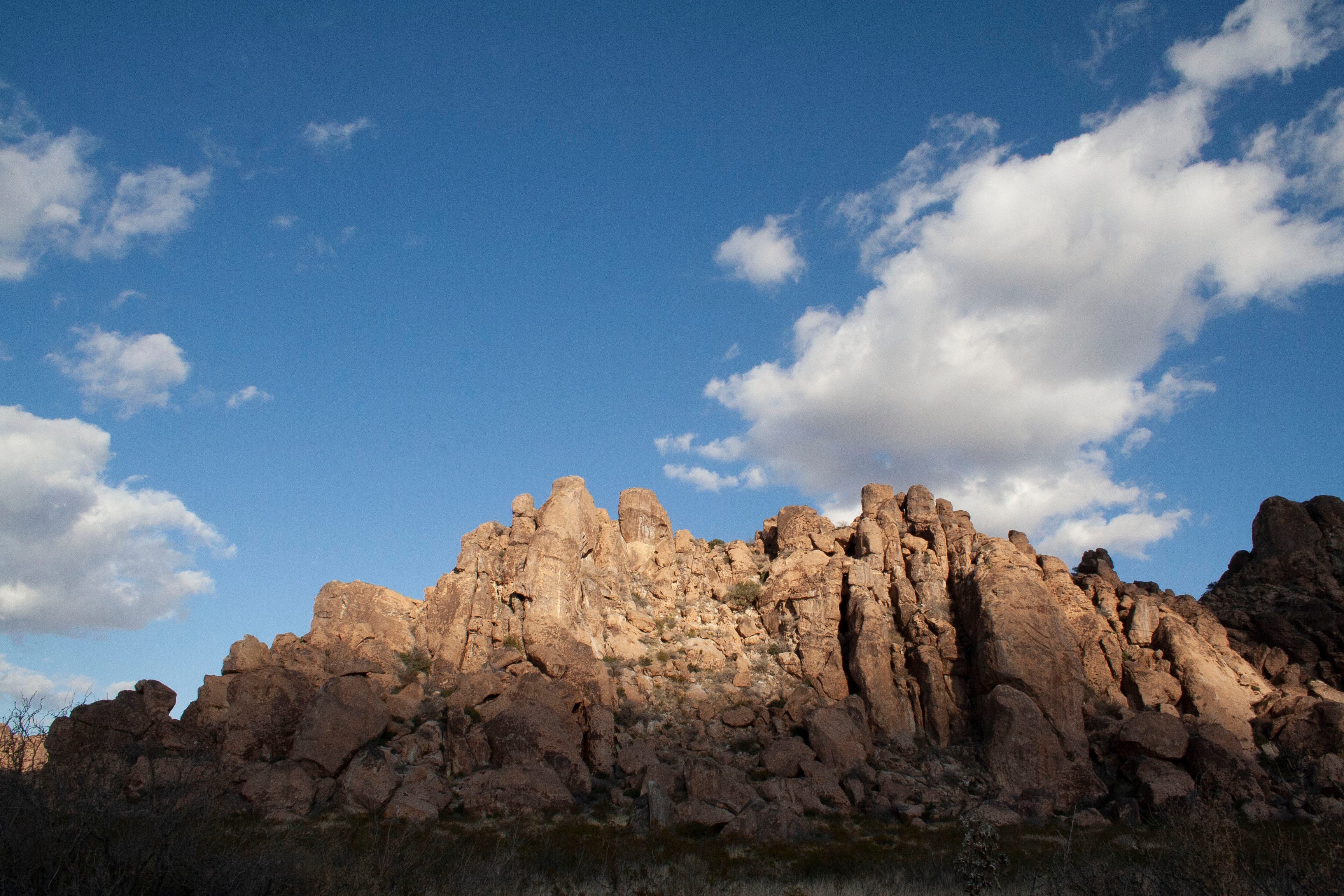
The Hueco Tanks, West Texas. Photograph by Gregory McNamee.
One, the American plant geographer Forrest Shreve, spent years trying to work out a satisfactory explanation of just what constitutes a desert. “It is impossible,” he concluded regretfully, “to define desert in terms of a single characteristic, just as truly as it is impossible to differentiate species by such a procedure.” He went on to suggest at least a few features that distinguish deserts from other places: irregular and modest rainfall, the low level of moisture in the soil, the swift winds and correspondingly high evaporation rate of surface waters, the land’s poorly developed drainage systems, the widely spaced plant life, and rocky or sandy ground.
To this we might add another qualification: The desert proclaims itself openly. There is no hiding its essential nature, unlike in my home state of Virginia, a place of greens so intense and various that you suspect that this is why computer monitors are made to show millions of colors, where the sheerest cliff and gentlest plain alike are carpeted in vegetation. No, the desert is all signal, with very little noise to distract us from it. There, in its multiple shades of brown, white, black, and gray, there is no clutter. Anything out of place is easily noticed, from a border crosser’s discarded knapsack to a developer’s strip mall.
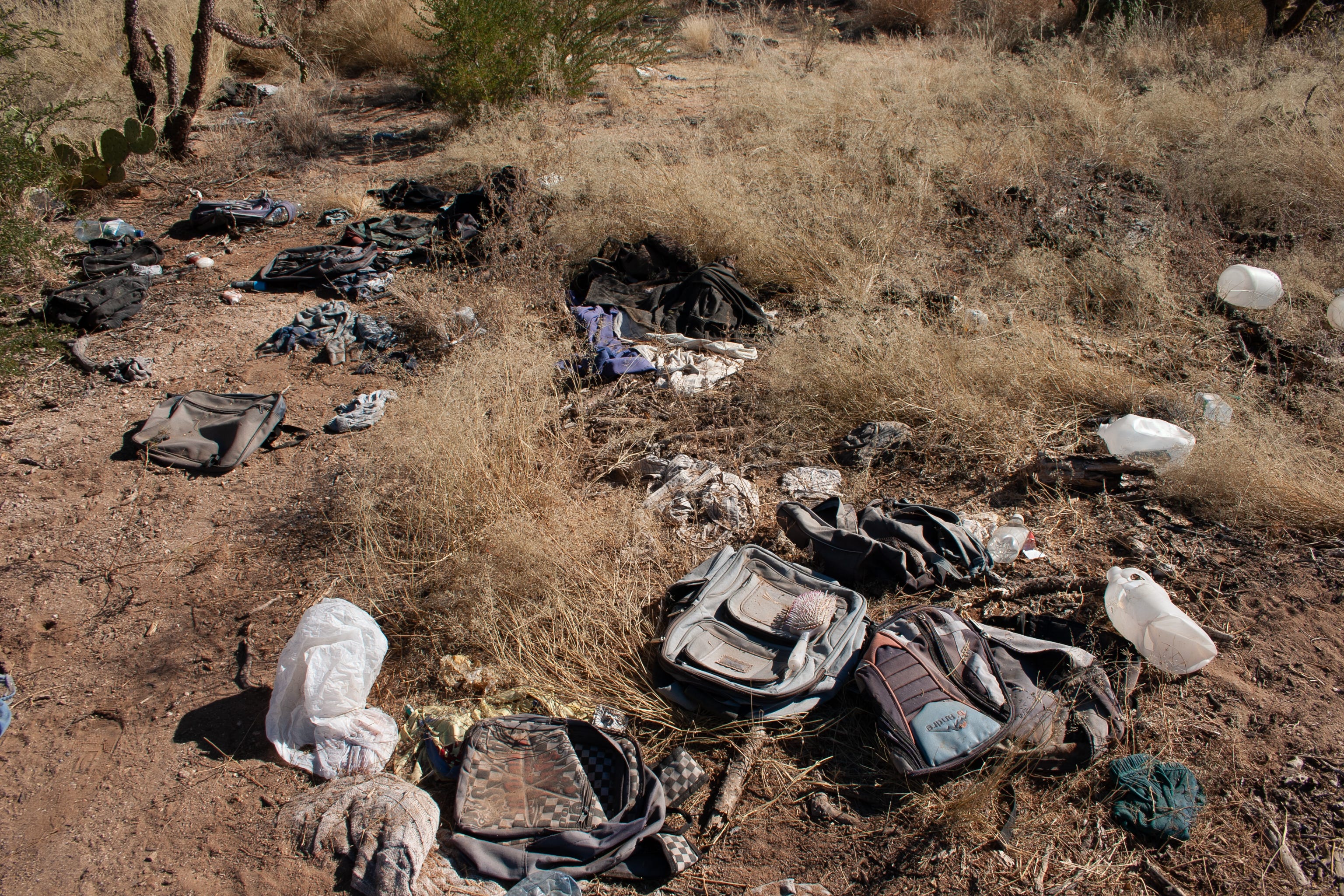
Discarded packs and clothes at the Arizona–Mexico border. Photograph by Gregory McNamee.
The world’s desert systems, which make up some 20 percent of the planet’s surface, comprise harsh environments: landscapes of burning sands and desiccated vegetation, gravel and dead streambeds, and everywhere a chaos of mountains and dust. They are less single entities than a multifaceted series of microenvironments, which some scientists break down into types like sicci deserta (dry desert, like that of the Great Basin), mobili deserta (wandering desert, like the great dunefields of the central Sahara and of the westernmost Sonoran Desert, where California, Baja California Norte, and Arizona meet), rupi deserta(rocky desert, like that of southern Arabia and the Laramide orogeny–formed hoodoo fields of the Arizona highlands), and saxi deserta (stony desert, like that of central Afghanistan and the Papaguería). By one measure, such microenvironments, punctuated by riparian corridors and mountain-island systems very familiar to those of us who live in the Southwest, comprise the largest geographical feature on Earth: the Eurasian Palearctic Desert, which begins at the Atlantic and ends very near the Pacific, embracing the Saharan, Arabian, Iranian, Turkmen, Indian, Taklamakan, and Gobi deserts.
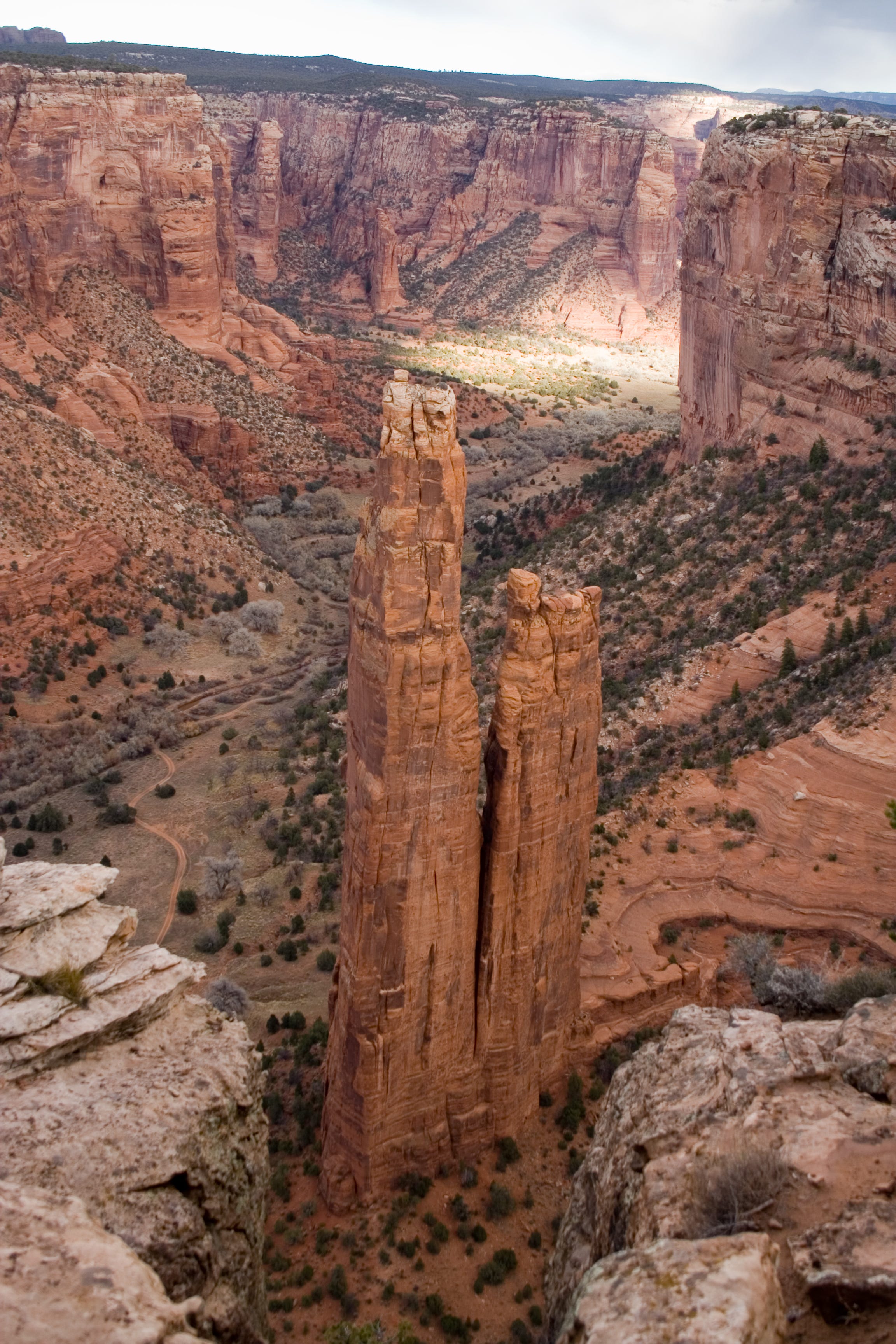
Canyon de Chelly, Arizona. Photograph by Gregory McNamee.
We have many ways to define deserts: Köppen indexes, relative and absolute precipitation, proximity to the horse latitudes, and so on. But in the end, our definitions turn on absences. A desert lacks. It lacks water. It lacks vegetation. In any sane regime, it lacks people, certainly as compared to better-watered lands. And in that lacking lies the essential clarity of the desert as it should be: there is nothing to disguise the desert, nothing to cover it up, nothing to muffle its signal.
Absences. Most deserts, in truth, are far from desolate. They swarm with life, albeit life that snarls, hisses, howls, bites, stings, or sticks. True enough, deserts lack water. But they do not lack for one thing: wind, and lots of it. What makes them deserts in the first place is not so much the absence of water as the fact that ever-thirsty winds pull such scant rain as falls from the clouds back skyward before it can reach or penetrate the ground. You can see this in the eerie “virgo” rain phenomenon, where ghostly trails of falling water evaporate thousands of feet above the earth in the thermal-ridden air. In windy Bagdad, California, not a drop of rain fell on the earth for 767 days, from September 3, 1912, to November 8, 1914; yet the sky was full of clouds in their season, water kept from the earth by the constant flow of desiccating wind. A similar arid river blows across West Texas, so strong, local legend has it, that if it ever stopped all the cows would fall down.
This ever-gnawing wind, coupled with water and the passage of eons, eats away at the earth. More signal: nowhere else does the land speak more plainly to the power of the elements. Nowhere else does it bear such striking testimony to the immensity of time.
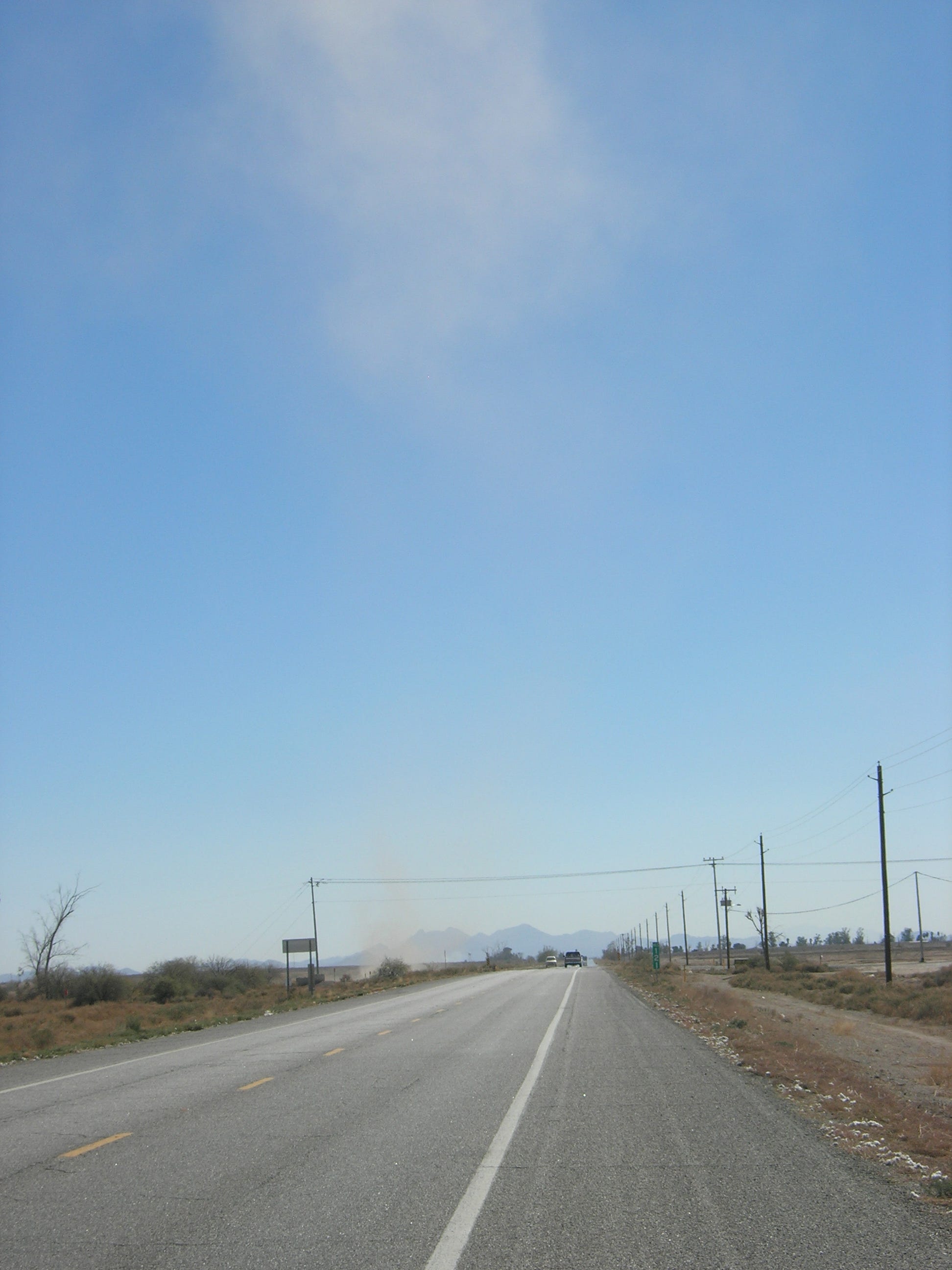
A dust devil. Photograph by Gregory McNamee.
Deserts are not in fact deserts at all—from the Latin desertus, a desolation, a place devoid of people, of life, abandoned by all but scorpions and ghosts. What there is, is: rock, sand, animal and plant communities well adapted to local conditions, as the expression has it. And what there is not—well, there is not, and in great abundance. That lack lies at the heart of the word Sahara, which, in Arabic, means “the brown void.” The desert is a sprawling chapter in the great book of time.
The Tohono O’odham, the Desert People, tell of water serpents that dwell in the boiling summer clouds that rage across deserts the world over, bringing rain to the dry earth not in nourishing drop but in great black undulating curtains of water, leaving floods and destruction in their wake. It is no sin to kill such serpents, the O’odham explain, but even their best shamans and archers rarely succeed in doing so. During one such thunderstorm in Arizona in the summer of 1941, a saltwater clam fell from out of the sky on a young boy, who was knocked out cold by the blow. He fared better than the playwright Aeschylus, on whose bald pate an eagle, thinking it was a rock, dropped a tortoise, killing both writer and chelonian instantly.
Sky and earth: in few places do the two form a more perfect union—and one that is dramatic and sometimes dangerous as well.
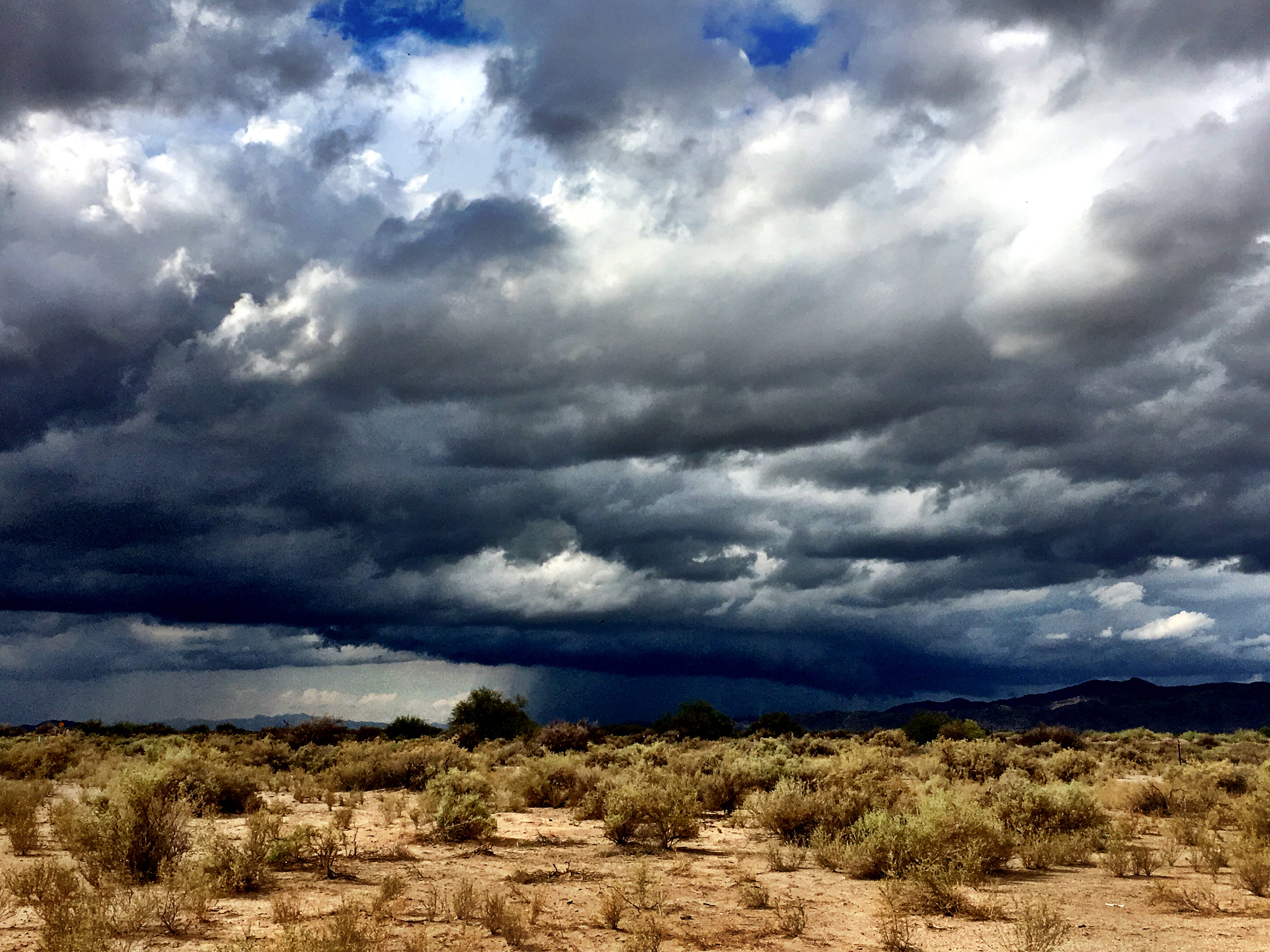
A monsoon storm over the Sierra Estrella, Arizona. Photograph by Gregory McNamee.
It is an aesthetic of silence and void that governs these places, an aesthetic that encourages direct observation of nature. The peach tree does not have to be taught how to be a peach tree, writes Ezra Pound somewhere. Just so, the desert does not have to be taught how to be a desert, though there are certainly parts of it that we might liken to a gentle kindergarten and others that offer the most rigorous postgraduate training.
In those lonely, difficult places, deserts breed strange visions. Mystics have seen gods, angels, and devils in whirlwinds of sand and flickers of heat lightning. Soldiers have seen great fortresses, carved by giants from civilizations past, in weathered sandstone cliffs. Conquerors have seen cities of gold beckoning from the edges of saltpans and the summits of sand dunes.
And desert rats and casual passers-by, from Lawrence of Arabia to Bugs Bunny, have seen white castles, gleaming cities, and even belly dancers floating on air above the scorching ground—and, more beguilingly still, pools of water where only sand and rock await.
These visions speak to a fact of the desert: such places are disorienting, and for reasons both meteorological and geological. If you stand at a high point in a field in, say, the piedmont of Virginia or the hill country of eastern Kansas or southern Ohio, places where the sky is full of moisture and the relief is broken by low rises and trees, your vision will be limited to something under three miles in any given direction. From a similarly high point in the middle of a valley in the basin-and-range deserts of the West, however, where rocky plains are bounded by mountains fifteen or twenty miles distant, that fifty-odd-square-mile domain grows a thousandfold. The absence of water in the atmosphere brings what would elsewhere be a hazy horizon into sharp focus, so that those faraway mountains stand out in distinct relief against the sky. It is hard to judge distances in such conditions, and many a traveler has perished by underestimating the amount of hot, waterless ground to be covered.
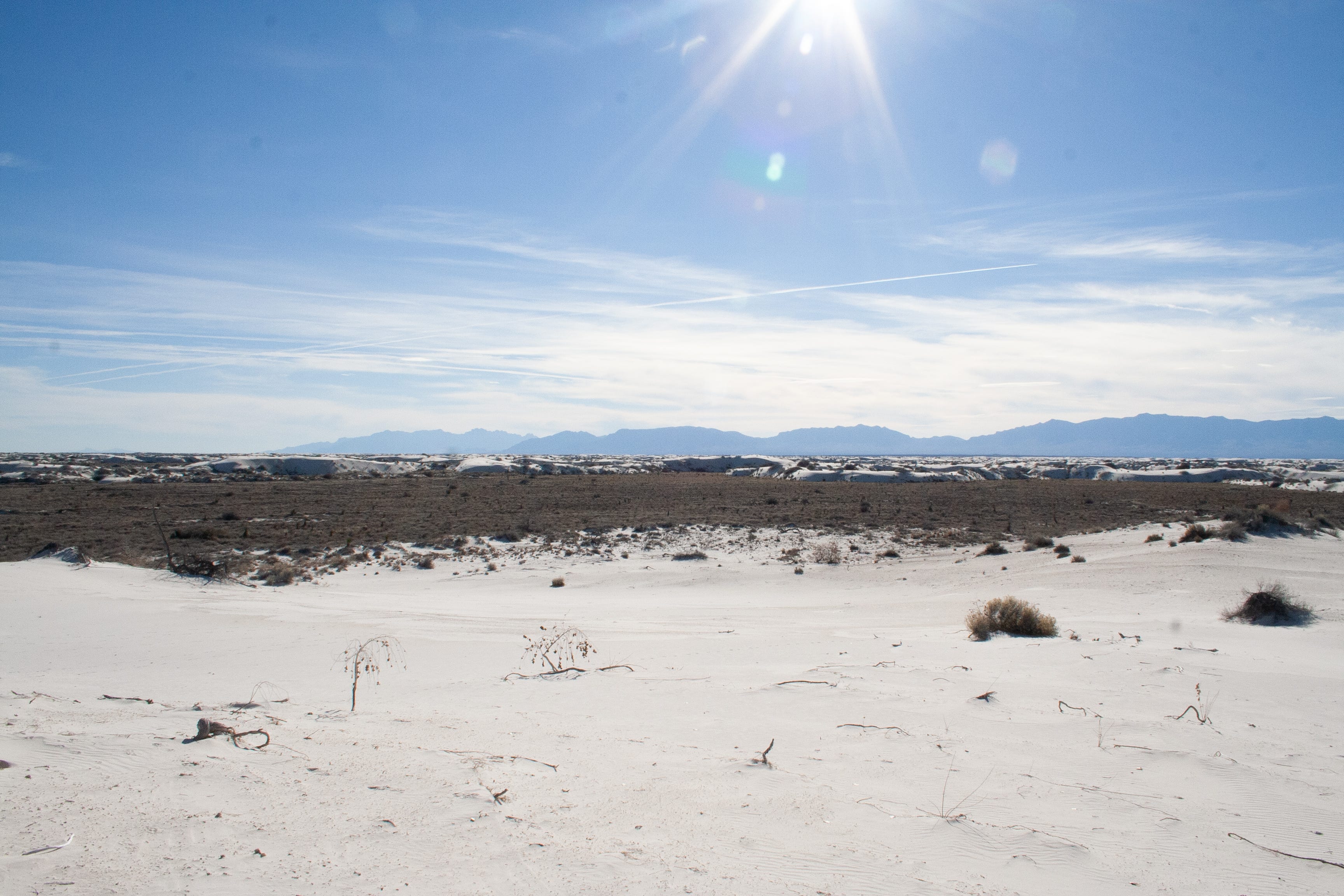
White Sands National Park, New Mexico. Photograph by Gregory McNamee.
Thus the desert’s clearest signal: Pay attention. Show respect. Ponder the passage of time: how little we have of it, how much these places have seen.
Be aware. Beware.
The desert—land of djinns, whirlwinds, mirages, and thundering sands, sharp rocks, diamantine skies—does not tolerate our inexperience. It assures us of our many imperfections, tests us and finds us wanting. And it demands that we adjust our viewpoint, seeing in it not absence but an embarrassment of riches.
Mae West
History hasn’t recorded for us how many happy fellows took up Mae West’s often-quoted (and misquoted) invitation, “Why don’t you come sometime and see me? I’m home every evening. . . . Come up, and I’ll tell your fortune.” There were many over her long life, but far fewer than West’s onscreen image would lead us to believe. She was too busy for all that, for what she did at home every evening defies the legend: she read, she thought, and she wrote.
Born on August 17, 1893, West as of the hardest-working woman in show business in her day, and possibly any day. Few knew this, for West kept her labors a secret, staying out of the nightclubs and off the party circuit and, in her quiet Hollywood apartment, learning the fine art of playwriting line by line.

A vaudevillian who had learned her stagecraft performing for unforgiving audiences, West was a natural master of timing and delivery, a gifted comic, and a beauty of note. All these things, she realized, were good of a kind, but only by winning creative control could she build the legacy she wanted. And so she turned out dozens of scripts, built an archive of clippings and notes, and maintained a gag library that would have done Bob Hope proud, working over quips and corny old jokes until they spoke her language: “When caught between two evils I generally pick the one I’ve never tried before.” “When I’m good, I’m very good. But when I’m bad, I’m better.” “Marriage is a great institution. I’m not ready for an institution.”
All that hard work might have found only a local following had not the Depression come along and sent West, a familiar presence on the New York stage, to Hollywood. She made the move 90 years ago, in 1932, strictly for the money. If she wasn’t enthusiastic about it, she kept her reservations to herself. Soon she was the highest-paid performer in the film business, earning $399,166 in 1934 alone. (By contrast, according to West biographer Simon Louvish, Marlene Dietrich pulled in $145,000, while Cary Grant made only $39,708.) Much of the income came from script sales, since West wrote most of her own vehicles or at least her own lines, including such hits as My Little Chickadee and I’m No Angel.
For its part, an anxious army of censors made its reservations very well known. In her native New York, West had been arrested many a time and her plays closed down for supposed obscenity. On landing in Hollywood, she now faced the strictures of the Hays Office, which distributed a list of some thirty thou-shalt-nots to film studios effectively banning profanity and nudity, along with depictions of interracial romance, white slavery, drug use, and just about any kind of amorous activity beyond holding hands. Such restrictions were like kryptonite to West, who busied herself trying to get around them with a suitable quip: “It ain’t sin if you crack a few laws now and then, just so long as you don’t break any.”
One stratagem became a trademark, the use of suggestive phrases and double entendres that anyone could see had a naughty component, but that could be explained away as innocent remarks: Come up and see me? Only a dirty mind—or a censor—would interpret that as anything other than a friendly gesture, West would object.
The Hays Office was unmoved, and the rules got tighter and tighter until, by 1943, the 50-year-old star was more or less forced out of films. She became an icon, while her writing took an increasingly private turn. When the rare offer to act came, she usually turned it down, refusing to play any woman over the age of twenty-six, a curious stance for a septuagenarian to take even with a phalanx of magic-making makeup artists at her disposal. Thus came only a few odd sightings of West in her later years, including the 1970 film Myra Breckenridge and a surreal appearance on the TV show Mister Ed.
West made an image for herself and inhabited it wholly, but her characters were not her. She was a pioneering feminist, screenwriter, and civil-rights advocate who made sex and all its pleasures and hypocrisies her great subject, and she merits the loyalty and affection of every film buff.
Mae Westisms
“It’s better to be looked over than overlooked.”
“A hard man is good to find.”
“When women go wrong, men go right after them.”
“I freely chose the kind of life I led because I was convinced that a woman has as much right as a man to live the way she does if she does no actual harm to society.”
“Is that a gun in your pocket or are you just glad to see me?”
“I believe in censorship. After all, I made a fortune out of it.”
“I only like two kinds of men: domestic and foreign.”
“Too much of a good thing is wonderful.”
“It’s hard to be funny when you have to be clean.”
“I wrote the story myself. It’s all about a girl who lost her reputation but never missed it.”
“Good girls go to heaven. Bad girls go everywhere else.”
“I’m not good and tired, just tired.”
Getting a Haircut in Ancient Rome
Strictly speaking, this isn’t a “hot” topic as such, but I was thinking of my many visits to Italy, a couple of them doing archaeological fieldwork in the full heat of summer while sensible Italians headed to cooler climes.
Imagine that George S. Patton, the brilliant armored tactician of World War II, had a penchant for wearing his hair in long curls, like George Armstrong Custer. Imagine further that American men, to honor Patton, started sporting hairstyles in the 1940s that wouldn’t come along until the 1960s.
That’s just how it was with Publius Cornelius Scipio, a Roman general who went off to battle in North Africa, defeated the armies of Hannibal in 202 BC, and returned to Rome a hero, now called “Scipio the African.” In the manner of Roman men of his time, he’d gone off to war wearing a heavy beard and vigorous curls, but he returned clean-shaven and shorthaired, in the manner of the Greeks. Soon a few Romans cut off their beards and cut their hair short, then a few more, and then a few others, whereupon an enterprising senator named Ticinius Mena traveled to the Greek colonies in Sicily, recruited a few professional tonsores, or barbers, and set up shop in the Eternal City.
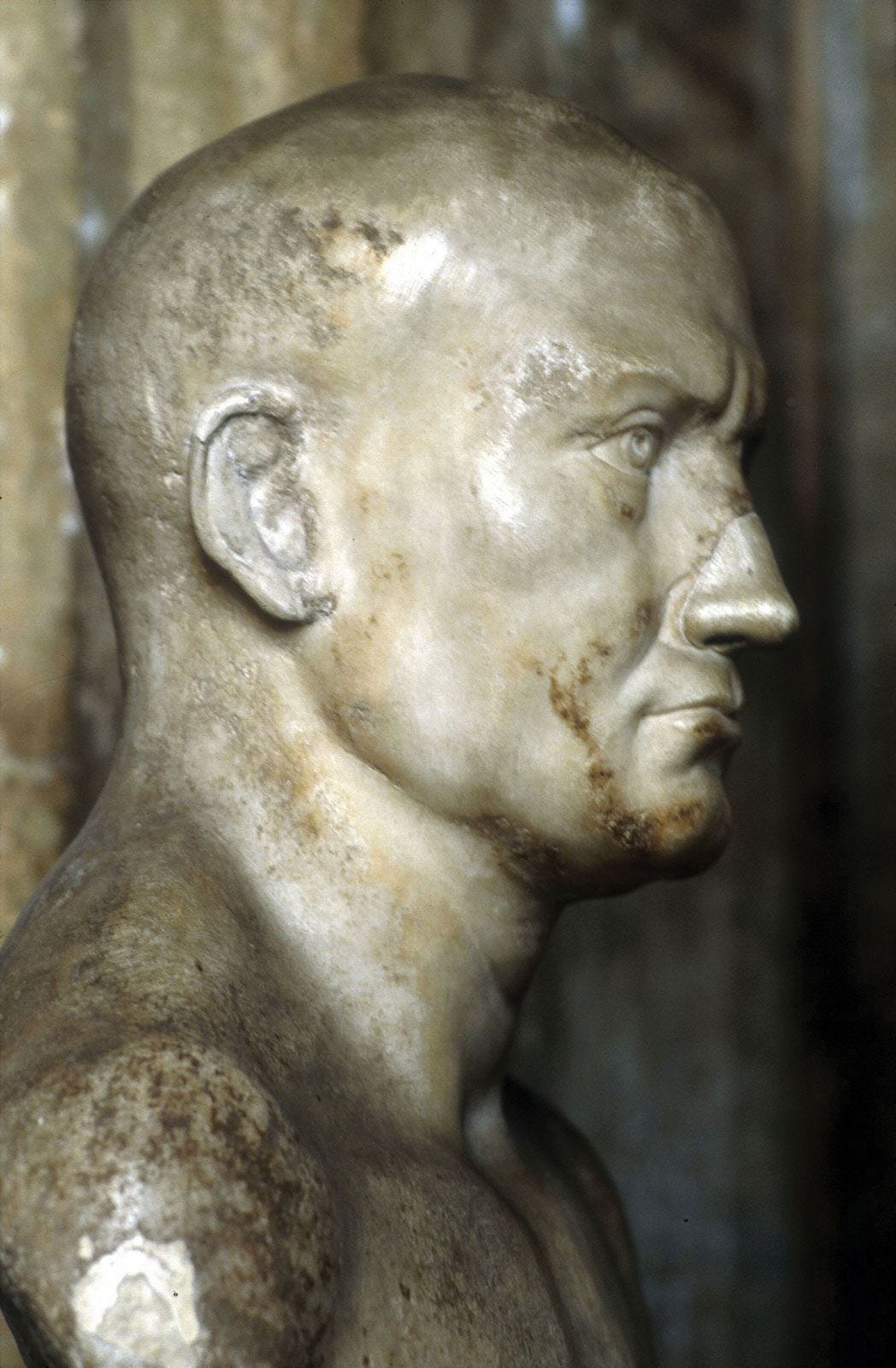
Publius Cornelius Scipio.
For the next six centuries, the men of Rome were mostly clean-shaven. What’s more, they were clean-shaven and sociable, since, except for the very rich who could afford private barbers, getting a haircut and a shave was a matter of going down to the local bathhouse. Noisy, chaotic, crowded places, the public baths housed numerous tonstrinae, or barbershops, that did a thriving trade. As with barbershops ever since, these establishments became social centers where men gathered to trade stories, jokes, and the ancient equivalent of stock tips, while barbers busily scraped away their beards with bronze razors shaped like half-moons and cut their hair with carefully sharpened knives.
Since shaving cream had yet to be invented, the scraping hurt. The braver men among them opted for something more painful still, depilation accomplished with beeswax. The bravest still even had a tooth or two extracted, for barbers doubled not only as surgeons, as in the England of old, but also as dentists.
Emperors and other important public personages remained trendsetters over the course of Roman history, setting fashions in motion. When Trajan adopted a Beatle haircut in the 2nd century, plenty of Roman men followed suit, while Nero’s pomaded wave found plenty of imitators until, happily, Nero—a very bad man, history tells us—was assassinated. It’s from fear of being killed in such a way, in fact, that one prominent Roman had his daughters learn barbering so that they could shave him. When, after a time, he came to think that he couldn’t trust even them, he had chestnuts heated until they were red-hot and then burned off his beard, a procedure that would inspire many a lesser man to take on the shaggy look of the nearest Gaul or pray for a baby face.
Most Roman men with less at stake, though, prided themselves on their appearance and spent a great deal of time combing, brushing, and otherwise sprucing up. Besides, they equated shagginess, the so-called “natural look,” with the ways of the barbarians outside Rome’s gates, and they cut their hair short and neat precisely to contrast themselves with those hairy foreigners, who, the Romans thought, were too busy scraping up acorns from the forest floor to pursue such civilized pursuits.
It’s ironic, then, that many Roman writers—men, of course—comment so archly about the excessive amount of time women of their day spent at the beauty salon. Hair, then as now, was seen as a symbol of one’s wealth and status: the more elaborate the hairstyle, by that thinking, the more important the woman who sported it.
In the days of the early Caesars, a high-born Roman woman would have worn her hair in what was called the nodus, with the hair parted down each side of the head to form three sections, the sides pulled back into a bun while the top was flipped over on top of itself in a luxuriant wave. Add to this a halo of ringlets and curls, and it was no surprise that a woman could spend half a day in the beautician’s chair.
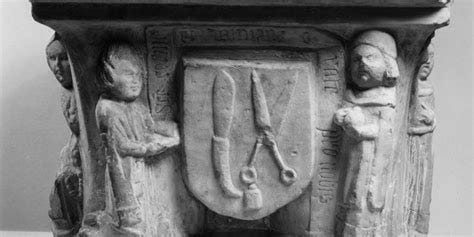
Roman barbers.
Some women, though, favored a somewhat simpler style, parting the hair down the middle and then tying it back in a bun. This style evolved in time into the braided long tresses tied back in a bun that women of the period following the death of Nero in 68 AD favored—Nero, who sported muttonchop sideburns, having been so spectacularly vulgar and ostentatious that a good tonic of simplicity was called for.
In time, Roman women returned to more elaborate styles, some building towering beehives of curled hair atop their heads, others cutting their hair very short and donning formidable wigs. As is true of fashion in most times and places, Roman women put a premium on looking just a shade different from their peers, and to this end they enlisted the help of wigmakers whose products were fantastically expensive, especially when the hair they used came from the blonde heads of women from Scandinavia or the jet-black hair of women from the Middle East and India. A full-length wig, called a capillamentum, could reach waist length, and the most expensive of them combined hair of different colors to create a contrasting, visually striking effect. Shorter, less expensive wigs were pinned onto a woman’s natural hair, though bald men tended to use them as toupees simply by gluing a wig to the pate.
The very wealthiest of Romans, men and women alike, kept slaves called ornatrices (the word “ornate” is in plain sight there) whose job it was to look out after the master and mistress’s hair and especially to pluck out any offending gray hairs that might crop up between dyes. Recipes for dyes could be dauntingly elaborate, and the best beauty salons employed dyers who possessed the equivalent of a doctorate in chemistry today to cook up recipes that involved everything from clay to tree bark to leeches and the boiled internal organs of pigs. Exotic spices and plant dyes were also employed, the most expensive of all being saffron imported from Spain and henna brought to Rome from North Africa.
Men and women paid through the nose for their beauty treatments. Now, sticker shock is no stranger to anyone looking for a shave and a haircut in a fashionable salon today, to say nothing of a perm or a dye job at a tony beautician’s. For that reason, barbers and hairdressers, being in high demand and short supply, earned plenty of sesterces back in the day.
The Emperor Julian, by one report, once sent for a barber to cut his hair. The barber arrived so lavishly costumed that Julian was moved to remark, “I had no idea that a barbers did so well.” He asked the tonsor how much he earned, and the barber replied that it was enough to keep twenty horses in his stable and twenty servants in his household. Offended that an ordinary mortal could do as well as a nobleman, Julian, it’s said, expelled all the barbers from Rome—and, for good measure, all the private chefs in the city. For several years, until Julian’s death in AD 363, Roman men, not wishing to offend him, thereafter went about in beards, and perhaps with rumbling stomachs, too.
A Latin teacher in our high school had a reply to any student whom she could not understand: “musitans in barba “ (mumbling in your beard)