Flying Critters
June 2026

Mosquitos and bats. Along with snakes, they inspire fear and loathing in many people. There’s good reason for that, but these critters exist for a reason. Here are three takes (one peripheral) on skeeters, and one on flying mice. Read on…
Malaria is a horrific malady. A parasitic disease spread mostly by mosquitoes, it manifests itself with flulike symptoms: chills, fever, uncontrollable sweating, the inability to hold down food and, for that matter, the loss of any desire to eat. In its extreme forms, it causes joint pain so intense that the ancient Greeks called it “the bone breaker.” Left untreated, the illness can bring on death—as it does, each year, to more than 650,000 people, the vast majority of them in equatorial Africa.
Malaria, whose name comes from the Italian phrase meaning “bad air,” has long been associated with tropical heat in wet, humid surroundings, the very definition of the equatorial world. Historically, though, its spread lay far beyond the tropics. It afflicted the ancient Greek and Roman world, and indeed all of the Mediterranean; one of the major accomplishments of Benito Mussolini’s otherwise disastrous fascist regime was to drain the swamps around Rome, ending millennia of misery caused by the disease.
It reached as far north in Europe as the marshlands surrounding Saint Petersburg, Russia, and the North Sea coast of Germany, which did not free itself from malaria until after World War II. In China, medical writers described the effects of malaria some 2,500 years ago, recommending herbal treatments to help ease a sufferer’s pain, many of them in use today. And some historians of the American Revolution have even theorized that one reason the revolutionaries finally won was not the unpopularity of the war back home in Britain or the arrival of French allies, but the simple fact that the Americans who fought the closing campaigns of the war in the South were more acclimated to malarial fever than were the unfortunate British, many of whom returned home ill and would remain so for the rest of their lives.
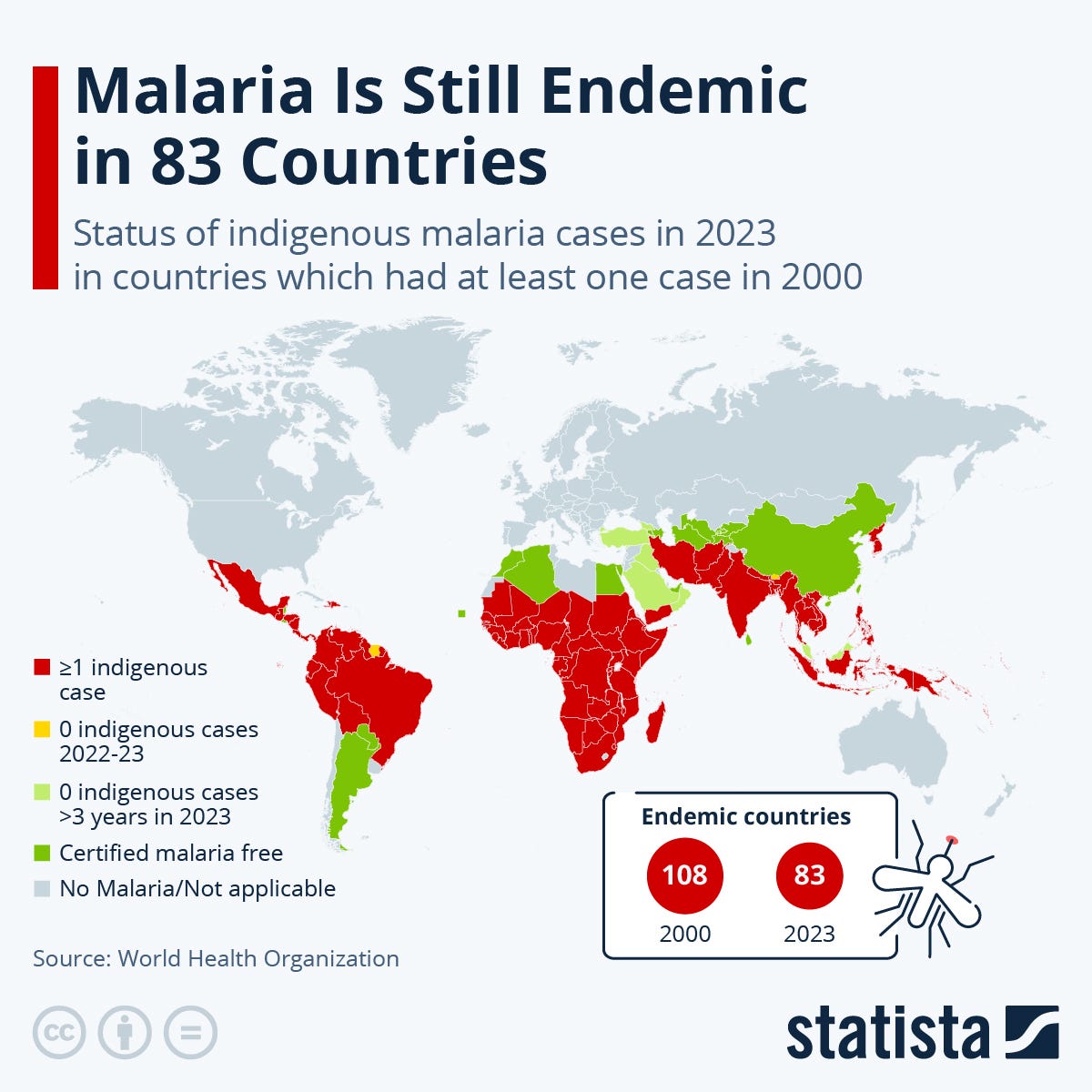
Several efforts on the part of scientists and healers in various parts of the world helped curb malaria in the last couple of centuries. One was the discovery that the bark of the tree called cinchona in Peru, anglicized to “quinine,” helped control the feverish symptoms of malaria. Too, the discovery that mosquitoes transmit malarial parasites—a discovery that won British scientist Ronald Ross the Nobel Prize in 1902—gave public health officials something to fight against: The problem wasn’t “bad air” as such, but bad inhabitants of that air.
